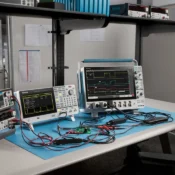


An oscilloscope probe is a device that makes a physical and electrical connection between a test point or signal source and an oscilloscope. Depending on your measurement needs, this connection can be made with something as simple as a length of wire or with something as sophisticated as an active differential probe. Essentially, a probe is some sort of device or network that connects the signal source to the input of the oscilloscope.
How oscilloscope probes work
An oscilloscope probe provides a quality connection between the signal source—or device under test (DUT)—and an oscilloscope. There are a number of important considerations when choosing and using an oscilloscope probe, including the physical attachment, impact on circuit operation, and signal transmission.
The anatomy of an oscilloscope probe
Most probes have at least a meter or two of cable associated with them. Probe cables allow the oscilloscope to be left in a stationary position on a cart or bench top while the probe is moved from test point to test point in the circuit being tested. However, the probe cable may reduce the probe’s bandwidth in some cases. Therefore, the longer the cable, the greater the reduction. 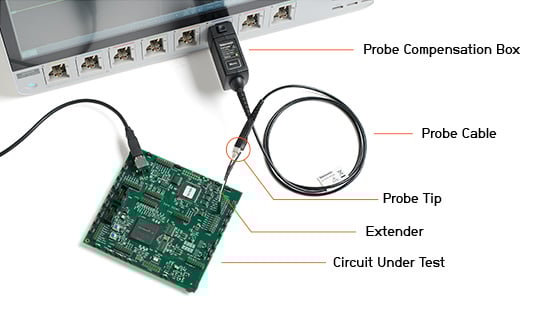
Most probes also have a probe head, or handle, with a probe tip. The probe head allows you to hold the probe while you maneuver the tip to the test point. Often, this probe tip is in the form of a spring-loaded hook that allows you to attach the probe to the test point.
Connecting the probes
Attaching the probe to the test point establishes an electrical connection between the probe tip and the oscilloscope input. So it is imperative that the probe have minimum impact (typically referred as “load”) on the probed circuit and that it maintains adequate signal fidelity for the desired measurements. If the probe doesn’t maintain signal fidelity, or if it changes the signal in any way or changes the way a circuit operates, the oscilloscope sees, and therefore reports, a distorted version of the actual signal.