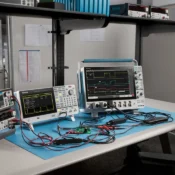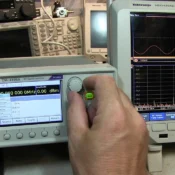


An oscilloscope, formerly known as an oscillograph (informally scope, oscope, or o-scope), is an instrument that graphically displays electrical signals and shows how those signals change over time. It measures these signals by connecting with a sensor, which is a device that creates an electrical signal in response to physical stimuli like sound, light and heat. For instance, a microphone is a sensor that converts sound into an electrical signal.
Here we’ll cover everything you need to know about an oscilloscope from how it works to how to find the right one.
History of the oscilloscope
In 1897, a German physicist named Karl Ferdinand Braun invented a cathode ray tube and, along with it, the first oscilloscope, which was expanded upon decades later by the company A. C. Cossor. In 1934, the first commercial oscilloscope was released by General Radio, and it became the first to be used outside of a laboratory. And in 1946, Howard Vollum and Melvin Jack Murdock founded Tektronix, which has gone on to become a world leader oscilloscopes. Since then, Tek has continued releasing innovative new technologies, including the first digital oscilloscope in 1971 and the first oscilloscope-to-cloud software solution—TekDrive—in 2020. Oscilloscopes are a staple of any engineer’s bench and have even been featured in famous films throughout history. You can visit the Tek museum website to see a complete list of oscilloscopes in films.
What is an oscilloscope used for?
Oscopes are often used when designing, manufacturing or repairing electronic equipment. Engineers use an oscilloscope to measure electrical phenomena and solve measurement challenges quickly and accurately to verify their designs or confirm that a sensor is working properly.
Who uses an oscilloscope?
Scientists, engineers, physicists, repair technicians and educators use oscilloscopes to see signals change over time. An automotive engineer might use an oscilloscope to correlate analog data from sensors with serial data from the engine control unit. Meanwhile, a medical researcher might use an oscilloscope to measure brain waves. There is no shortage of applications for this powerful instrument.
How does an oscilloscope work?
There are three primary oscilloscope systems: vertical, horizontal and trigger systems. Together, these systems provide information about the electrical signal, so the oscilloscope can accurately reconstruct it. The picture below shows the block diagram of an oscilloscope.

Oscilloscope vs. digital multimeter vs. voltmeter
Oscilloscope, digital multimeter, voltmeter—what’s the difference and are they interchangeable? A voltmeter measures the potential difference between two nodes on an electrical circuit. Though a digital multimeter also measures voltage, it can measure current and resistance as well. And an oscilloscope shows how the voltage changes over time. Typically, as the application becomes more advanced, so does the instrument.