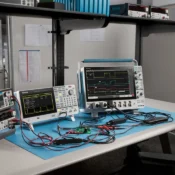

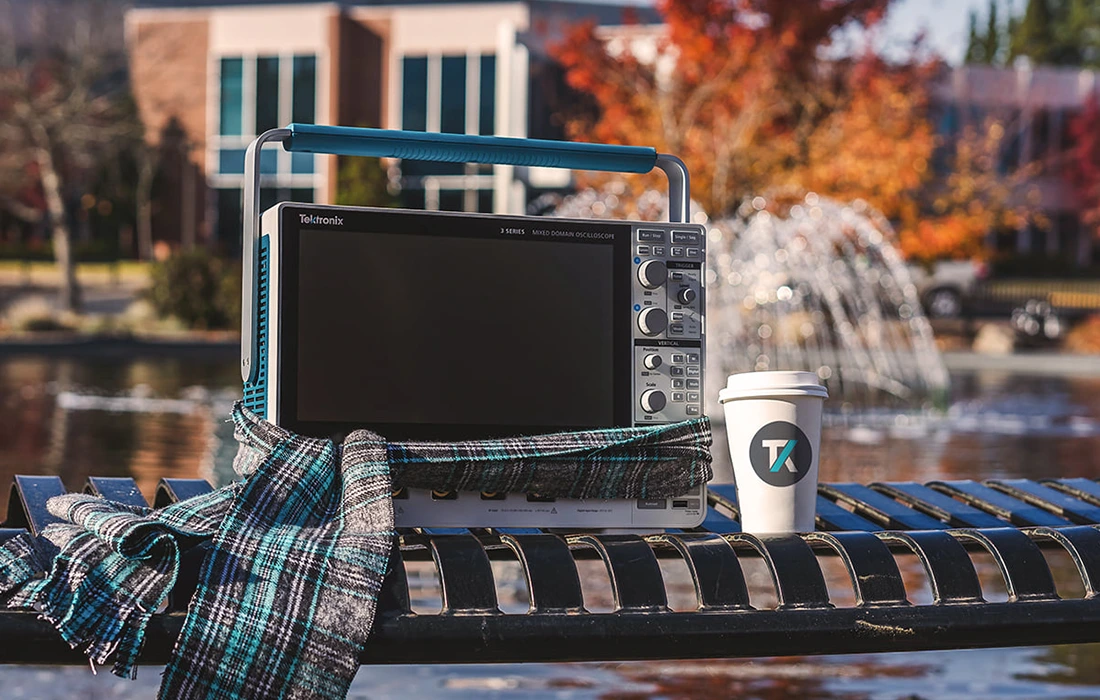
An oscilloscope, formerly known as an oscillograph (informally scope, oscope, or o-scope), is a benchtop instrument that graphically displays electrical signals and shows how those signals change over time. They are used by engineers to troubleshoot circuits and check signal quality. Most engineers use a digital oscilloscope, which is what we’re going to focus on here. Digital oscilloscopes acquire and store waveforms, which show a signal’s voltage, frequency, the portion of the signal that is noise, whether the signal is distorted, the timing between signals and more.
But when it comes to choosing the best oscilloscope, how do you know which oscope is right for your application? There are 10 primary factors to consider when you buy an oscilloscope. For a quick overview of the top factors, watch the short video below. Otherwise, keep reading for the full details on how to choose an oscilloscope for your application.
Oscilloscope bandwidth
System bandwidth determines an oscilloscope’s ability to measure a signal. Specifically it determines the maximum frequency that the instrument can accurately measure. Bandwidth is also a key determining factor in the oscilloscope price.
Good measurements begin at the probe tip. The scope and probe work together as a system, so be sure to consider probes when selecting an oscilloscope.
Oscilloscope rise time
Rise time describes the useful frequency range of an oscilloscope, and this is a critical measurement in the digital world. Rise time is often considered when measuring digital signals like pulses and steps.
Determine what you need – use the ‘five times rule’
In order to accurately capture the details of rapid transitions, an oscilloscope must have sufficient rise time. Fast rise time is also needed for accurate time measurements. To calculate the oscilloscope rise time required for your signal type, use this equation:

Triggering capabilities of an oscilloscope
All oscilloscopes provide edge triggering, and most offer pulse width triggering. To acquire anomalies and make best use of the scope’s record length, look for a scope that offers advanced triggering on more challenging signals.
Determine what you need

The wider the range of trigger options available the more versatile the scope (and the faster you get to the root cause of a problem):
- Digital/pulse triggers: pulse width, runt pulse, rise/fall time, setup-and-hold
- Logic triggering
- Serial data triggers: embedded system designs use both serial (I2C, SPI,CAN/ LIN…) and parallel buses.
- Video triggering
Oscilloscope record Length
Record length is the number of points in a complete waveform record. A scope can store only a limited number of samples so, in general, the greater the record length, the better.
Determine what you need
Time captured = record length/sample rate. So, with a record length of 1 Mpoints and a sample rate of 250 MS/sec, the oscilloscope will capture 4 ms. Today’s scopes allow you to select the record length to optimize the level of detail needed for your application.
A good basic scope for example will store over 2,000 points, which is more than enough for a stable sine-wave signal (needing perhaps 500 points), whilst more advanced high-end scopes would have up to 1Gpoints, which is essential for working with high-speed serial data type applications.
Oscilloscope waveform capture rate
Waveform capture rate, expressed as waveforms per second (wfms/s), refers to how quickly an oscilloscope acquires waveforms. The waveform capture rates of oscilloscopes vary greatly, so it’s important to find the right one for your application.
Determine what you need
Oscilloscopes with high waveform capture rates provide significantly more visual insight into signal behavior, and dramatically increase the probability that the oscilloscope will quickly capture transient anomalies such as jitter, runt pulses, glitches and transition errors.
Digital storage oscilloscopes (DSO) employ a serial processing architecture to capture from 10 to 5,000 wfms/s. Some DSOs provide a special mode that bursts multiple captures into long memory, temporarily delivering higher waveform capture rates followed by long processing dead times that reduce the probability of capturing rare, intermittent events.
Most digital phosphor oscilloscopes (DPO) employ a parallel processing architecture to deliver vastly greater waveform capture rates. Some DPOs can acquire millions of waveforms in just seconds, significantly increasing the probability of capturing intermittent and elusive events and allowing you to see the problems in your signal more quickly.
Oscilloscope expandability
As your needs change, you want an oscilloscope that can accommodate your needs with application modules and software updates.
Determine what you need
If you want to expand the capabilities of your oscilloscope over time, make sure your instrument has everything you need. For instance, some oscilloscopes allow you to:
- Add memory to channels to analyze longer record lengths
- Add application-specific measurement capabilities
- Complement the power of the oscilloscope with a full range of probes and modules
- Work with popular third-party analysis and productivity
- Windows-compatible software
- Add accessories, such as battery packs and rack mounts
Connectivity of an oscilloscope
After you’ve analyzed your oscilloscope measurements, you’ll need to document and share your findings. The connectivity of an oscilloscope delivers advanced analysis capabilities and simplifies the documentation and sharing of results.